





The three platforms solve different problems. Lobster controls complex data flows and EDI between ERP, suppliers and carriers. n8n and ByteChef automate workflows and deploy AI agents. The choice depends on whether the core need is structured B2B data integration or flexible process automation.
For a broad market overview with more tools, see our integration platform comparison. This article focuses on Lobster, n8n and ByteChef and on when each platform fits.
Key takeaways:
- Lobster is built for EDI, mapping and partner onboarding and connects ERP, suppliers and carriers on one platform.
- n8n and ByteChef automate internal workflows and deploy AI agents for decision and routing steps.
- n8n is free to self-host for internal use, while ByteChef is released under the Apache 2.0 open-source licence.
- In classic EDI, complex mapping and partner onboarding, n8n and ByteChef offer less depth than Lobster.
- Before an ERP migration, Lobster is suitable as the integration layer, while n8n or ByteChef fit pure workflow and AI automation.
What is Lobster built for?
Lobster is a data integration platform focused on EDI, mapping and supply-chain connections. You connect ERP, WMS, TMS, suppliers and carriers on one platform. Visual mapping, templates and protocol support (EDIFACT, X12, VDA, IDoc, AS2, AS4, OFTP and others) shorten partner onboarding from weeks to days.
You keep control of your data flows, because mapping changes run internally and the message history is visible immediately. Deployment is on-premises, in the Lobster Cloud, hybrid or on our Lobster platform as a managed service. You acquire the licence directly from Lobster. We operate the instance on the Lobster operating model and take care of monitoring, operations and further development. Data location is Switzerland or Germany.
The platform is built for high data volumes and complex partner networks. As a certified Lobster partner and value-added reseller we bring the platform into your business and keep it running.
The formats and protocols in brief
- UN/EDIFACT is the United Nations standard for the electronic exchange of business documents such as purchase orders, dispatch advices and invoices.
- X12 is the EDI standard widely used in North America, developed and maintained by the organisation of the same name.
- VDA refers to the message recommendations of the German Association of the Automotive Industry, for example for delivery schedules and delivery notes in the supply chain.
- IDoc (Intermediate Document) is the document format SAP systems use to exchange data with other systems.
- AS2 transmits EDI messages encrypted and signed over HTTP and confirms receipt with a receipt notice.
- AS4 is an OASIS profile for message exchange via web services and is used, among others, in the Peppol network.
- OFTP2 is the file transfer protocol of Odette, widely used in the European automotive industry.
What do n8n and ByteChef deliver?
n8n and ByteChef are visual workflow platforms for process automation and AI agents. They fit when the focus is on internal processes and classic EDI is secondary.
n8n connects hundreds of apps via nodes. You build process flows and deploy AI agents, and code nodes for JavaScript or Python extend the options. Self-hosting under the Sustainable Use License is free for internal use. Commercial hosting or embedding for external users requires a commercial licence from n8n. Which automations pay off in practice is covered in our article on n8n automations for companies in 2026.
ByteChef is an open-source platform under Apache 2.0, which makes it a genuine open-source n8n alternative. The visual canvas and code in several languages are included. You host it yourself or use the cloud, and when self-hosting you keep full data ownership. In the Enterprise Edition, embedded options allow integration into your own products. The connector library covers more than 250 components plus a generic HTTP client.
Both platforms offer less depth in classic EDI, complex mapping and partner onboarding than Lobster.
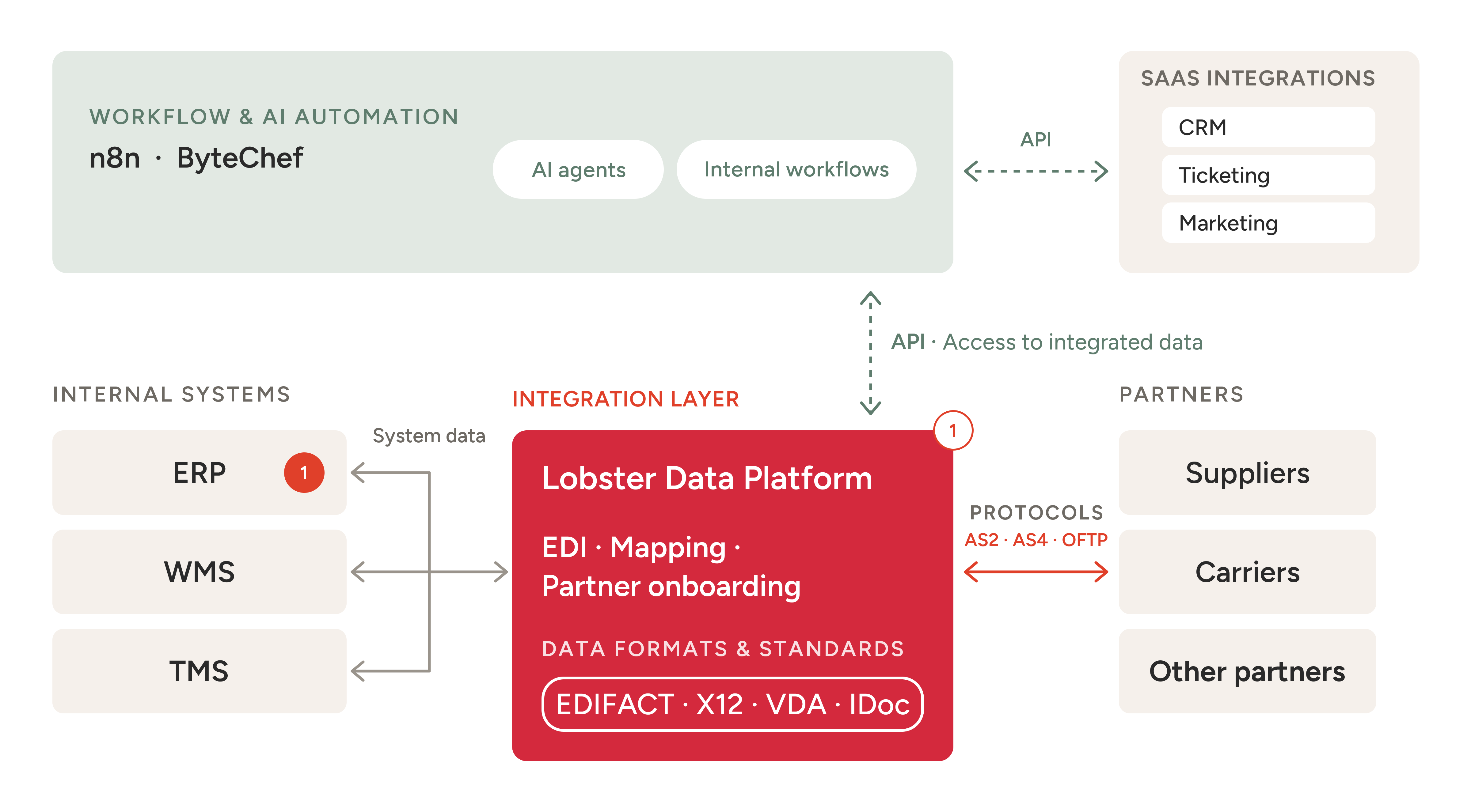
Architecture tip: ERP migration
Put the integration layer in place first, then switch the ERP. Suppliers and carriers will not notice the change.
How do Lobster, n8n and ByteChef differ?
The decisive differences lie in EDI and partner onboarding, deployment, licensing and AI agents.
| Criterion | Lobster | n8n | ByteChef |
|---|---|---|---|
| Core focus | EDI, mapping, supply-chain integration | Workflow automation, AI agents | Workflow automation, AI agents, embedded |
| EDI & partner onboarding | Strong (formats, protocols, templates) | Limited | Limited |
| Deployment | On-prem, Lobster Cloud, hybrid or managed service on our Lobster platform | Self-host or cloud | Self-host, cloud, embedded (Enterprise Edition) |
| Licence | Directly from Lobster | Sustainable Use License | Apache 2.0 |
| Visual mapping / builder | Strong for data transformation | Node-based for workflows | Canvas plus code |
| AI agents | Limited | Strong | Strong |
| Data ownership & control | High (own infrastructure or managed service) | High when self-hosted | High (Apache 2.0, self-host) |
| Enterprise governance | Strong | Good with Enterprise licence | Good, with embedded options |
| Best suited for | Complex B2B data flows, ERP migration, supplier connections | Internal automation, AI workflows | Internal automation, AI, embedding |
When is Lobster the better choice?
Lobster is the better choice for tasks where structured partner data and EDI are in the foreground. You need reliable data exchange with many partners and stable connections to ERP and logistics systems, and mapping changes should be possible internally and quickly.
Before an ERP migration you put the integration layer in place first, so suppliers and carriers do not notice the change. Lobster is designed for data quality, protocol variety and partner onboarding. You can operate the platform yourself or run it on our Lobster platform as a managed service. The licence sits with Lobster, and we take care of operations and further development on the Lobster operating model.
When do n8n or ByteChef fit?
n8n and ByteChef fit when the focus is on internal workflow automation and AI agents. You connect SaaS tools and deploy AI agents for decision or routing steps. The connection to classic EDI partner networks is secondary or already solved via another layer.
If self-hosting, full data ownership and low entry costs matter to you, n8n delivers this with a mature community and many nodes. ByteChef delivers genuine open-source freedom without fair-code restrictions and, in the Enterprise Edition, strong embedded options. Both fit when the emphasis is on workflow orchestration rather than deep B2B data mapping.
With AI agents it pays to take a realistic look at reliability. In the τ-bench benchmark (Yao et al., 2024), even leading models such as GPT-4o solved fewer than half of the tasks, and in the retail scenario they solved the same task in all eight runs in fewer than 25 per cent of cases. Agents therefore suit decision and routing steps well, while partner data flows with fixed formats should run deterministically.
How do you decide in practice?
Four steps are enough to determine the right category.
- List the systems and partners that must exchange data. These include ERP, suppliers, carriers and SaaS.
- Mark which connections require EDI or complex transformations.
- Check whether the main benefit lies in stable partner data flows or in internal process automation.
- Assess deployment and licence requirements. These include data location, self-host, managed service and embedding.
If the integration layer for ERP and partners is in the foreground, Lobster delivers the concrete benefit, operated yourself or on our platform as a managed service. For pure workflow and AI automation, evaluate n8n or ByteChef in parallel. How to plan the connection to your ERP step by step is covered in our practical guide to ERP integration.
Frequently asked questions
What is the fundamental difference between Lobster and n8n or ByteChef?
Lobster controls EDI, mapping and partner data flows. n8n and ByteChef automate workflows and AI agents. The difference lies in the core need, meaning whether you need structured B2B data integration or flexible process automation.
Which platform is better for EDI and supplier connections?
Lobster is designed for EDI and partner onboarding, with formats, protocols and templates already integrated. n8n and ByteChef offer less depth here.
Can I cover classic EDI with n8n or ByteChef?
Only to a limited extent. Both platforms suit workflows and API connections. Classic EDI with many partners and complex mapping is not solved at the same depth as with Lobster.
How do the deployment options differ, including managed service?
Lobster runs on-premises, in the Lobster Cloud, hybrid or on our platform as a managed service. n8n and ByteChef offer self-hosting or cloud. ByteChef additionally supports embedded use in its Enterprise Edition.
Which licence applies to n8n and to ByteChef?
n8n uses the Sustainable Use License, under which internal use is free while commercial hosting or embedding for external users requires a commercial licence. ByteChef is released under Apache 2.0, so you can use, modify and deploy it commercially.
When does the managed service on the Lobster platform make sense?
When you do not want to handle operations, monitoring and further development yourself. You acquire the licence from Lobster. We operate the instance on the Lobster operating model with data location in Switzerland or Germany.
Which platform suits as an integration layer before an ERP migration?
Lobster, because you put the integration layer in place first and suppliers and carriers do not notice the change. n8n and ByteChef are less suitable for this role.
How strong are the AI agent capabilities of the three platforms?
n8n and ByteChef offer strong AI agent capabilities. Lobster is limited here and focuses on data integration and EDI. For AI-driven decision and routing steps, n8n or ByteChef are therefore the better fit.
Next step
Send us your current integration list and the three most important partner or system connections. We will come back within two working days with a connection map and a realistic assessment of which platform or combination covers the need.