




What happens when half of your organic clicks disappear into AI-generated answers? When buyers stop searching themselves and send an AI agent instead? And when that newsletter with the personalised greeting still ends up in the archive?
None of these questions are hypothetical. All three describe shifts that began in 2025 and will become tangible in the daily work of marketing teams in 2026. The challenge isn’t finding new tools. It’s adapting existing processes and strategies so they keep delivering in this changed environment.
That’s what this article is about. We go through nine trends that, from our experience at W4 for the DACH region, will have the greatest leverage in 2026, and show where companies can concretely start.
Where Marketing Teams Actually Stand in 2026
Marketing budgets are under pressure. That’s not news for most teams. What is new is that channel complexity keeps growing without a proportional increase in impact. Many teams now manage twice as many channels as they did in 2022, with similar resources and rising expectations for measurable results.
In 2025, many companies rolled out AI tools at scale. Content generation, campaign optimisation, chatbots, analytics assistants: the options grew, and teams tried what was available. The result in practice is often a sprawling stack of individual tools that run side by side but don’t really work together.
2026 shifts the focus. It’s less about which new tools hit the market, and more about consolidating existing workflows, steering AI use strategically and creating clear responsibilities. The question is no longer “Are we using AI?” but “Who controls what AI does, and which results do we measure it against?”
Three forces shape every trend we discuss below:
- EU regulation: The AI Act, the Corporate Sustainability Reporting Directive (CSRD) and the Digital Services Act set new guardrails that directly affect marketing processes for companies in Switzerland, Germany and Austria.
- A cookieless world: Third-party cookies are disappearing for good. Organisations that haven’t yet built their own data infrastructure will lose both tracking options and the ability to reach audiences precisely.
- AI agents in the buying process: Increasingly, autonomous systems research and compare before a human even makes a decision. That changes how product information needs to be structured.
Trend 1: GEO Adds a New Visibility Layer on Top of Classic SEO
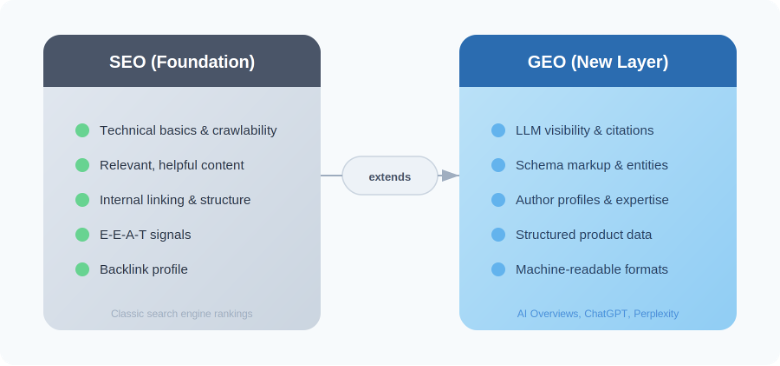
One thing first: GEO doesn’t replace SEO. Classic search engine optimisation remains the foundation. Without clean technology, relevant content and a crawlable site structure, no LLM will cite a website as a source. What’s changing is the visibility layer added on top.
A growing share of search queries is no longer answered with a list of ten blue links. Google AI Overviews, ChatGPT, Perplexity and Gemini deliver summarised answers directly in the interface. For users, that’s convenient. For companies, it means visibility increasingly depends on whether their website is cited as a source in these answers. According to an analysis by Rand Fishkin (SparkToro, 2024), roughly 60 percent of all Google searches now end without a single click on an external result.
In the DACH region, an additional pattern shows up: LLMs currently cite German-language sources less often than English ones. The models tend to fall back on English sources even when the query is in German. Companies that build their own ecosystem of citeable, structured German content have a clear advantage here.
What teams can check concretely:
- Schema markup for key entities: Organization, FAQ, Product and Author markup helps search engines and LLMs correctly classify content.
- Clear authorship: LLMs prefer content where verifiable expertise stands behind the text. Author profiles with subject area, experience and external references strengthen this signal.
- Machine-readable product data: AI agents barely process free-text PDFs. Structured product information on the site, on the other hand, works.
How Teams Can Tell Their Website Is Invisible to LLMs
Three signals visible without expensive tools:
- No clean entity structure: there’s no clear, machine-readable mapping between topics, people and products.
- Unclear authorship: articles without author name, field of expertise or external profile links. A core trust signal is missing for LLMs.
- Hardly any external citations: without references from trade media, industry directories or other websites, LLMs have no basis on which to rate sources as citeable.
For analysis, three tool categories are worth looking at: LLM visibility trackers, validators for structured data and brand mention monitoring in AI answers.
Trend 2: Agentic Marketing and Whether Your Product Data Is Machine-Readable
Agentic AI describes autonomous systems that carry out tasks on behalf of a human: researching, comparing providers, making preliminary selections, sometimes even booking or ordering directly. ChatGPT Operator is a well-known example. In the B2B space, specialised buying agents that automate procurement are emerging.
For the DACH region, this becomes especially relevant where structured procurement processes already exist. Purchasing departments in industry and the public sector are already testing agentic workflows in which AI systems analyse supplier data, compare product specifications and generate shortlists.
Three areas teams can prepare now:
- API-ready product catalogues that are machine-readable and can be queried automatically.
- Performance specifications in a structured format: clear fields for price, availability, technical data and delivery terms, rather than free text.
- FAQ sections that cover typical decision questions and therefore also work for agentic pre-selection.
Much of this is good practice anyway. The difference is that in 2026 these structures matter not only to human visitors but also to the AI systems researching before them.
Trend 3: First-Party Data Governance Needs a Foundation, Not a Project Plan
This trend weighs more heavily in the DACH region than in many other markets. The EU’s GDPR and Switzerland’s revised Data Protection Act (revDPA) have set the framework for years. What’s changing in 2026 is enforcement. Supervisory authorities in Germany, Austria and Switzerland are becoming more active.
For marketing teams, this means a shift in responsibility. CRM, Customer Data Platform (CDP) and Consent Management Platform are no longer purely IT topics. Marketing needs to understand what data is collected, how consent is documented and which activation use cases build on it.
One lever often underestimated in B2B is zero-party data: information that contacts share voluntarily through preference centres, progressive profiling in forms or in exchange for concrete value. A practical example: an industrial company offers a configurator where prospects enter their requirement profile. The resulting data is higher quality than any tracking and fully GDPR-compliant.
Mini Framework: Assess Your Organisation’s Data Maturity in 5 Minutes
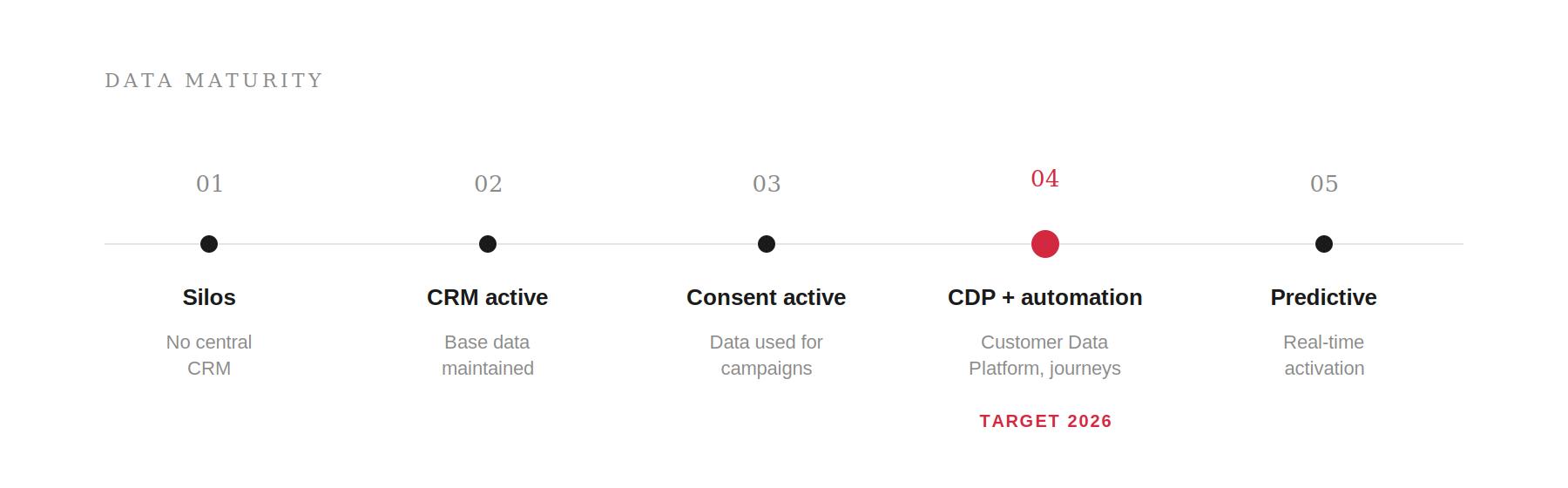
Five questions that enable an initial assessment:
- Is there a central overview of all data sources? Or is data scattered across CRM, newsletter tool, shop and Excel?
- Is the legal basis documented for each type of data collection? Can you demonstrate it in ten minutes?
- Is data actively used for campaigns and personalisation, or does it sit in the CRM mainly for reporting?
- Are retention periods defined, with processes for data subject requests (access, deletion, objection)?
- Does consent management work across systems: website, email marketing and campaign management?
Organisations uncertain about three or more of these questions should clarify their data infrastructure before the next campaign push. Only on a solid base does investment in CDPs or marketing automation platforms pay off.
Trend 4: From Standalone AI Tools to Integrated Workflows
In 2025, many teams tried AI tools: text generators, image tools, analytics assistants, chatbots. In many cases, this has produced an uncoordinated stack of individual tools. Different departments use different tools, results are merged manually, and nobody has a complete picture of which AI models process which corporate data.
In 2026, the question shifts. Instead of “Which AI tool do we use for task X?” it becomes: “How do we integrate AI into our workflows so it runs in the background without every step being triggered manually?”
This changes the role profile for marketing teams. The operational creation of content variants, performance data analysis and campaign setup will increasingly be handled by AI. What remains is strategic oversight:
- Which message fits the brand?
- Which tone is right for which audience?
- Where is AI setting the wrong priorities?
For companies in regulated industries, the EU AI Act adds another dimension. It requires organisations to classify AI systems, assess risks and provide transparency over automated decisions. This is especially relevant for healthcare, biotech and the public sector.
Trend 5: Personalisation That Delivers ROI, and Personalisation That Burns Budget
Technically, personalisation is further along than ever. AI systems can adjust content in real time to behaviour patterns, location, time of day and purchase history. The question is no longer whether it’s possible. The question is where it pays off and where it hurts.
In B2B, there are clear areas with measurable ROI:
- Lifecycle communication: an existing customer who just implemented a product needs different information than a new contact in the orientation phase.
- Account-based marketing for major accounts: targeted outreach that translates directly into pipeline value.
- Context-based product discovery: content that adapts to the user’s current situation.
At the same time, there are areas where personalisation costs more than it returns. The classic newsletter with a first-name merge tag and a generic subject line is the best-known example. Effort and impact rarely line up here.
In the DACH region, a regulatory aspect comes in. GDPR and the revised Swiss DPA set clear limits on profiling and automated decisions. These aren’t theoretical requirements — they’re the points regulators ask about concretely in audits.
Trend 6: Social Search Changes Where Product Research Begins
A growing share of product research no longer starts with Google but on social platforms. TikTok, Instagram, YouTube and Pinterest are used as search engines by younger audiences, especially in retail and tourism. For manufacturing or the public sector, the trend is less pronounced, but even there the way decision-makers find information is shifting.
In the DACH region, social commerce adoption lags behind the US and Asia-Pacific. The reasons are structural: different payment habits, higher data privacy sensitivity and a more B2B-driven mid-market. For retail companies, the shopping features on Instagram and TikTok are still worth watching, as the platforms are specifically expanding these functions in European markets in 2026.
The most important consequence for marketing teams concerns measurability. Last-click attribution no longer works reliably in a world with social search. Multi-touch attribution or incrementality testing reflect reality better but require organisational changes to reporting.
B2B Special Case: LinkedIn as a Search Engine for Decision-Makers
In 2026, LinkedIn effectively functions as its own search ecosystem for many B2B audiences. Decision-makers research topics, solutions and vendors there. Company pages, executives’ personal profiles and the newsletter feature are SEO assets within the LinkedIn ecosystem.
Corporate influencers don’t need an elaborate personal branding programme for this. A pragmatic framework is often enough:
- One topic area per person
- One to two posts per week
- A short briefing on current company topics
Trend 7: When Content Works Without Anyone Clicking
Zero-click content is content that delivers value without anyone needing to click a link. LinkedIn carousel posts that fully answer a question. AI overviews that show information directly in search. Featured snippets that summarise the core of an article.
Dark social describes content sharing in private channels: WhatsApp groups, Slack channels, Signal chats, closed communities. This sharing is invisible to analytics tools because it leaves no referrer.
This has two consequences for marketing teams.
First, the KPI system. Website traffic as the central success metric increasingly misleads in many B2B contexts. Better indicators:
- Brand search: how often is the brand name searched directly?
- Share of voice in relevant topic areas
- Number of qualified conversations from inbound inquiries
Second, content production. Content should be designed to deliver value even without a click. A LinkedIn post that answers a concrete question strengthens the brand even if nobody clicks through to the blog article. At the same time, every piece should have a clear sender so the brand association holds even when shared in a WhatsApp group.
Trend 8: Translating CSRD Data Into Brand Communication
The Corporate Sustainability Reporting Directive (CSRD) has required detailed sustainability reporting from many large EU companies since 2024/2025. For marketing departments, this is more relevant than it first appears. The CSRD generates data, metrics and evidence that can be translated into credible communication — provided it’s prepared well.
Greenwashing will be spotted faster and punished harder in 2026 than before. Vague promises like “climate-neutral” or “sustainably produced” no longer suffice.
For marketing teams, the opportunity is to move CSRD data from mandatory report into brand communication. A concrete example:
- Before: “We’re committed to sustainability.”
- After: “Our CO2 footprint per produced unit has dropped by 18 percent since 2023. By 2027, we plan a further reduction of 12 percent.”
Industry relevance varies. Manufacturing, tourism, healthcare and retail are most affected. Foundations and NGOs have their own dynamic because donors and stakeholders expect transparency regardless of CSRD obligations.
Trend 9: Real Voices Are Worth More Than Any AI-Generated Post
In an environment where AI-generated content becomes standard, recognisably human voices gain value. The more content is produced by machine, the more what feels genuine stands out.
Communities become more valuable than pure follower counts in 2026. An active community of 500 experts who regularly ask questions and share content is worth more to a B2B company than 50,000 passive followers. Such communities deliver:
- Qualified demand
- Direct product feedback loops
- Stronger employer branding
A concrete model we use at W4 in projects is the “Brand Asset Toolkit” approach. Companies make usable building blocks available to their community: industry data that would otherwise sit behind a paywall. Visual templates teams can reuse in their own presentations. Frameworks and checklists that help in daily work. These building blocks carry the brand and generate organic reach without the marketing team having to write every post themselves.
Corporate influencers play a growing role here. Leaders who speak publicly on their area of expertise create credibility that no corporate channel can build alone. The effort doesn’t have to be huge: one clear topic area per person, regular short posts and an internal briefing on current themes.
Your Roadmap for the Next 90 Days
Trying to implement nine trends at once is the surest way to do none of them well. What works in practice is a focused start in three steps.
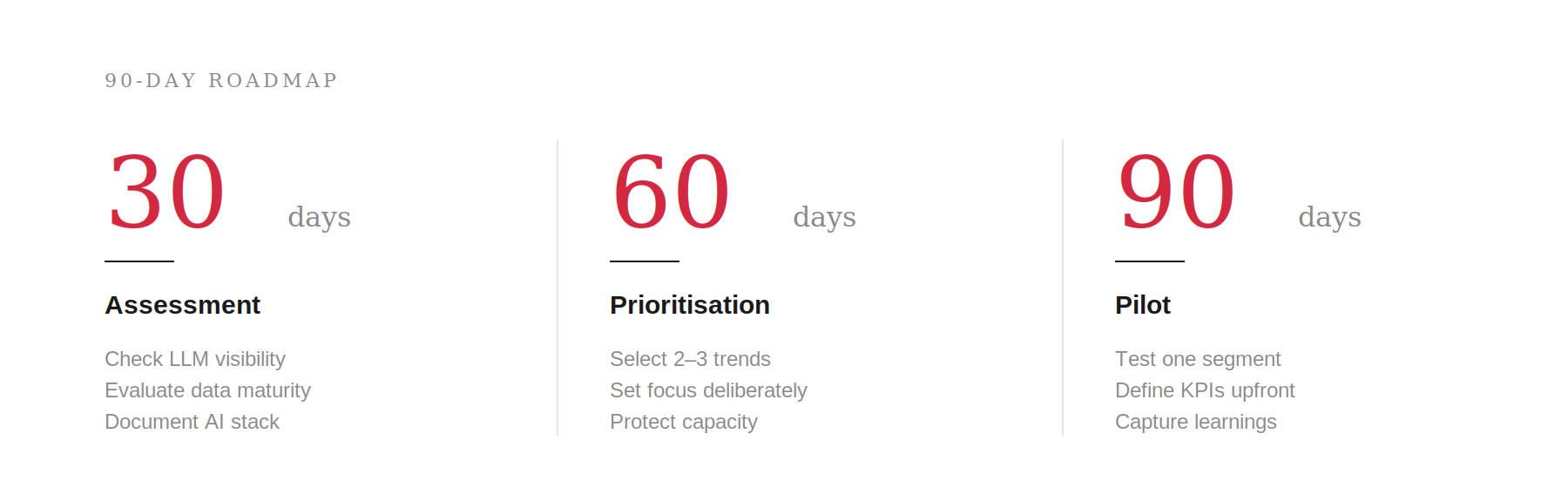
The first 30 days: assessment.
Three priorities are enough to start:
- How visible is your website in AI-generated answers?
- How mature is your first-party data infrastructure?
- Which AI tools does your team use and which corporate data do they process?
This assessment doesn’t need to be a major project. Two to three focused workdays are often enough.
Days 30 to 60: prioritisation.
Based on the assessment, you can evaluate which two or three trends deliver the greatest leverage for your business model. Equally important is the deliberate decision about which trends to tackle later. An industrial company with complex product data will prioritise agentic marketing and GEO over social commerce. A retail company will set different priorities.
Days 60 to 90: pilot.
Instead of rolling out broadly, we recommend starting with a clearly scoped pilot. One product segment, one audience, one channel. With success metrics defined in advance.
Conclusion: What Really Matters in 2026
Machines and humans are both the audience for marketing teams in 2026. Both read differently, and both need structured, relevant content. Optimising only for Google misses the LLM layer. Optimising only for AI agents loses the human connection.
Your own data deserves the same strategic attention as campaign budgets. Organisations that treat their data infrastructure as a one-off project will hit walls in 2026. Data is the foundation for personalisation, attribution and any form of targeted communication.
Human expertise and transparent communication can’t be copied structurally. That makes them the strongest differentiator in a world full of AI-generated content. Authorship, community work and honest sustainability communication are investments that pay off long-term.
If you’re thinking about where your team should focus in 2026, talk to us. We’ll help you prioritise the trends with the greatest leverage for your business model and support you through implementation. Step by step.