






AI increases productivity in knowledge work by expanding the range of tasks that can be done. Not primarily through time savings and not by replacing expertise. Those who only roll out tools often get more correction effort. Those who redefine the scope of work and retain professional judgment get real productivity.
Most debates still treat intelligence as a scarce resource. It is hoarded, protected, or its loss is feared. This view is wrong. Historically, the assumption of scarce resources hindered the transition to productive growth. The same is happening with AI. Intelligence is becoming cheaper. People can do more and more ambitious work because the marginal benefit increases.
Key takeaways:
- 65 percent of Swiss AI users perform higher analytical and creative work than last year.
- Expertise and professional judgment remain the limiting factor, AI only extends the lever.
- Productivity arises when the organisation redefines the scope of work.
- Leadership decides whether the scope of work expands or only more volume arises.
Does AI replace knowledge work or expand its scope?
AI expands the scope of knowledge work because intelligence becomes cheaper and demand for it rises. People invest more cognitive effort when more becomes possible. For companies in Switzerland and Germany, what matters most is which work suddenly becomes feasible that previously failed due to cost or capacity.
Most debates still treat intelligence as a scarce resource that must be hoarded or protected. Historically, this view hindered the transition to capitalism. The same is happening with AI. The real shift is an abundant supply of intelligence and a rising return on knowledge work.
In his article on Contraptions (“Cognitive Mercantilism”, 25 October 2026), Venkatesh Rao describes current AI panic as “Cognitive Mercantilism”. Intelligence is treated like bullion in historical mercantilism: scarce, hoardable, and best kept under the control of elites. The counter-thesis is that supply and demand are elastic. When intelligence becomes cheap, demand for it rises. People invest more voluntary cognitive effort because more becomes possible. The analogy to the Industrial Revolution in early capitalism is clear. New possibilities create new demand, not less work.
Cognitive Mercantilism explained
Venkatesh Rao draws on Joyce Appleby's 2010 book The Relentless Revolution, a history of capitalism. According to Appleby, mercantilism rested on four beliefs, which Rao transfers to intelligence.
- Wealth is scarce and finite. Transferred, intelligence is hoarded like bullion.
- Ordinary people cannot be trusted with much freedom. Transferred, intelligence is considered safe only in the hands of certified elites.
- Thinking revolves around supply and its control. Demand for intelligence barely registers.
- Most people are good only for simple labour. Automation would therefore supposedly create billions of useless minds.
Rao points out that the agricultural revolution did not produce a world full of useless mouths. Vastly more people could do other work while enjoying access to vastly more food.
For the practical application of AI in companies in Switzerland and Germany, this serves as an orienting framework. The relevant question is not whether AI replaces jobs. The relevant question is which work suddenly becomes feasible that previously failed due to cost or capacity.
What does the data show on AI productivity in Switzerland?
According to the Microsoft Work Trend Index 2026, Swiss AI users outperform their global peers on productivity. The gap lies with leadership, because only a minority see a clear AI strategy. The AXA SME labour market study 2026 also shows that many SMEs consciously use or test AI and hardly expect job reductions.
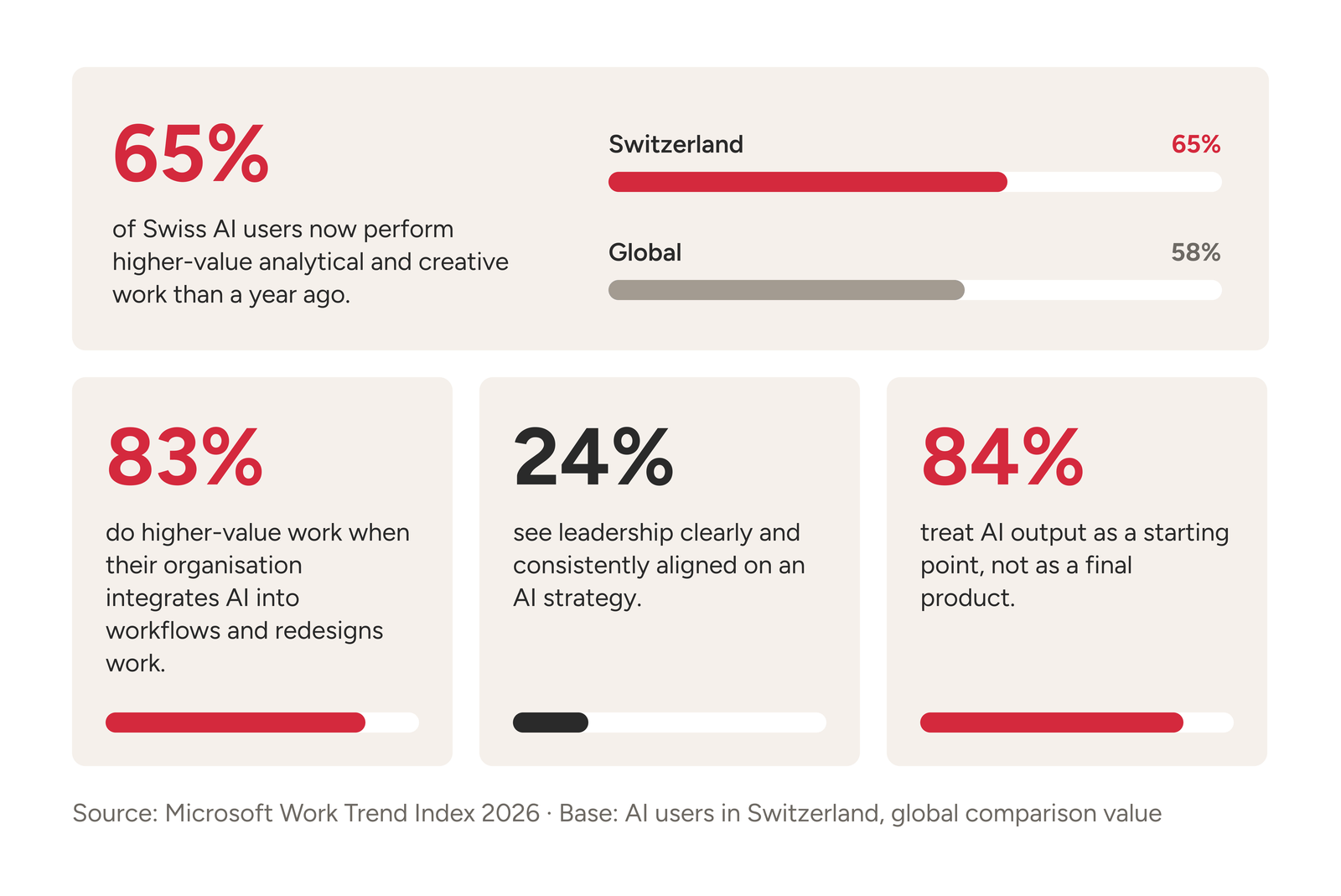
Swiss AI users achieve above-average productivity. According to the Microsoft Work Trend Index 2026, 65 percent of Swiss AI users can now perform higher analytical and creative work than a year ago. Globally the figure is 58 percent. Among employees in organisations that integrate AI into workflows and redesign work, the share in Switzerland rises to 83 percent.
At the same time, only 24 percent of Swiss AI users say that leadership is clearly and consistently aligned on an AI strategy. Almost half find it safer to focus on current goals than to redesign work with AI.
The AXA SME labour market study 2026 (Sotomo, 336 SMEs) shows a similar picture. 35 percent of Swiss SMEs consciously integrate AI into their processes. 39 percent are testing it. Of the SMEs with AI experience, 47 percent expect time savings without an impact on headcount. Only 12 percent expect job reductions. The savings do not flow into higher value creation.
| Metric | Value | Source |
|---|---|---|
| Swiss AI users who can now perform higher analytical and creative work than a year ago | 65 percent (globally: 58 percent) | Microsoft Work Trend Index 2026 |
| Share in organisations that integrate AI into workflows and redesign work (Switzerland) | 83 percent | Microsoft Work Trend Index 2026 |
| Swiss AI users who say leadership is clearly and consistently aligned on an AI strategy | 24 percent | Microsoft Work Trend Index 2026 |
| Swiss AI users who treat output as a starting point, not as a final product | 84 percent | Microsoft Work Trend Index 2026 |
| Swiss SMEs that consciously integrate AI into their processes | 35 percent | AXA SME labour market study 2026 (Sotomo) |
| Swiss SMEs testing AI | 39 percent | AXA SME labour market study 2026 (Sotomo) |
| SMEs with AI experience that expect time savings without an impact on headcount | 47 percent | AXA SME labour market study 2026 (Sotomo) |
| SMEs that expect job reductions | 12 percent | AXA SME labour market study 2026 (Sotomo) |
Further studies show the same pattern. Many employees spend one to two hours per week correcting AI-generated content. Freed-up time is more often invested in further technology than in developing employees. Productivity does not arise automatically. It arises when the organisation redefines the scope of work.
What does expanding the scope of work mean in practice?
With AI, tasks become feasible that previously failed due to capacity. Research covers more sources and variants, documentation can be updated continuously, and scenarios are cross-checked in parallel. The bottleneck shifts to selection and validation, and this expertise remains with the human.
Content and research become more comprehensive and integral.
A single research or content pass now covers far more sources, variants and counter-arguments than a small team could previously manage. The bottleneck shifts to selection and validation. Those who previously created a market analysis with three sources and one draft can now check ten variants in parallel and select the most robust one. Expertise remains with the human. The scope of possible analysis increases.
Technical documentation and process mapping become updatable.
ERP or integration documentation is created and updated faster. The scope of work expands to variant analyses and impact assessments that previously failed due to available capacity. Process mapping that used to take a week can now be created in one to two days and run through several scenarios. Professional judgment and quality control remain the limiting factor.
Competitive intelligence and variant analysis become parallelisable.
More scenarios are calculated and cross-checked in parallel. Professional judgment remains the bottleneck, not the raw research. Teams can seriously examine more options before deciding. The quality of the decision rises when the number of examined variants increases and validation remains systematic.
According to a field experiment by Dell'Acqua and colleagues (Organization Science 2026), consultants using AI completed 12.2 percent more tasks and worked 25.1 percent faster. On a complex task outside the capabilities of AI, they were 19 percentage points less likely to reach a correct solution with AI.
These examples are not tool tips. They show where the productivity gain arises. Not in pure speed, but in the expansion of what becomes feasible within existing expertise.
Why does professional judgment remain the bottleneck?
Professional judgment remains the bottleneck because AI output only becomes reliable after validation and quality control. Without this review, more volume and more rework arise. AI accelerates the preparatory work, while people still carry responsibility for the result. The high quality expectations in Switzerland and Germany make this attitude particularly important.
84 percent of Swiss AI users treat output as a starting point, not as a final product (Microsoft Work Trend Index 2026). That is the right attitude. Without validation and quality control, correction effort arises instead of productivity.
Expertise and professional judgment remain the limiting factor. AI extends the lever. It does not replace it. Those who ignore this produce more volume and more rework with little higher output. Those who respect it achieve a massive expansion of the scope of work. In Switzerland, with its dual system and high quality expectations, this attitude is particularly relevant. This Swiss Finish or German Finish expects reliable results. AI accelerates the preparatory work. Responsibility for the result remains with the human.
What role does leadership play in productive AI use?
As leaders, you decide whether AI expands the scope of work of your teams or only creates more volume. It works best to deliberately reinvest freed-up time into higher value creation, such as deeper analysis or strategic thinking. Those who simply fill the time saved with additional tasks give away this gain.
AI tools alone are not enough. Leadership decides whether an expansion of the scope of work takes place or only more volume arises. Only 24 percent of Swiss AI users see this clear leadership alignment. Organisations that deliberately reinvest freed-up time into higher value creation achieve better results. Employees use the time for deeper analysis or strategic thinking. Those who only put the time into further tools or increase the workload miss the productivity gain. The decision lies with management: to redefine the scope of work or to increase volume.
Conclusion
AI makes intelligence cheaper. Productivity gain in your organisation arises when you redefine the scope of your knowledge work, but retain professional judgment. Swiss and German organisations have an excellent starting position with their above-average individual productivity. The gap lies in organisational implementation.
How can you expand the scope of your knowledge work with AI while keeping professional judgment in your hands? At W4, we support companies with AI consulting from concept to delivery. If you are planning your next step with AI, talk to us.

Frequently asked questions
Does AI increase productivity in knowledge work or only speed?
AI increases productivity above all when it expands the scope of feasible work. Teams check more variants, cover more sources and complete tasks that previously failed due to capacity. More speed without validation, on the other hand, often leads to additional correction effort.
Why do most SMEs not expect job cuts from AI?
Swiss SMEs with AI experience mainly expect time savings without an impact on headcount. Only a small minority expects job reductions, and this figure has remained stable over three survey years. SMEs currently see AI mainly as a tool that supports employees.
How can freed-up time be kept from flowing into correction effort?
Treat AI output as a starting point and review it systematically for quality. Invest the time gained deliberately in higher value creation, such as deeper analysis or strategic thinking. Additional tools or a higher workload alone do not solve the problem.
What does expanding the scope of work mean for an engineering or consulting team?
A consulting team can now check a market analysis in ten variants in parallel, where three sources and one draft used to be the norm. Process mapping that took a week can be created in one to two days and run through several scenarios. Selection and validation remain the task of the experts.
Why is rolling out AI tools not enough?
Tools alone do not change the scope of work, leadership makes that decision. What matters is whether freed-up time is deliberately reinvested into higher value creation. Otherwise more volume and more rework arise with hardly any higher output.
What does cognitive mercantilism mean?
The term comes from Venkatesh Rao and describes the attitude of treating intelligence like bullion in historical mercantilism, as a scarce and hoardable resource. Rao counters that demand for intelligence rises when it becomes cheaper. As a result, more tasks become feasible that previously failed due to cost or capacity.